

As a supplier of epoxy coated thermistors, I often encounter inquiries from customers about whether these components are self - heating. This topic is crucial for understanding the performance and reliability of thermistors in various applications. In this blog, I will delve into the concept of self - heating in epoxy coated thermistors, exploring the factors that contribute to it and its implications in practical use.
Understanding Self - Heating in Thermistors
Self - heating in thermistors occurs when electrical power is dissipated within the thermistor itself, causing a temperature rise above the ambient temperature. This phenomenon is a result of the relationship between the current flowing through the thermistor and its electrical resistance. According to Joule's law, the power dissipated (P) in a resistor is given by the formula (P = I^{2}R), where (I) is the current and (R) is the resistance.
Epoxy coated thermistors are no exception to this principle. When an electric current passes through an epoxy coated thermistor, the electrical energy is converted into heat. The epoxy coating, which is used to protect the thermistor element, can also affect the heat dissipation process. If the heat generated within the thermistor cannot be dissipated efficiently to the surrounding environment, the temperature of the thermistor will increase.
Factors Affecting Self - Heating
Several factors influence the degree of self - heating in epoxy coated thermistors:
1. Electrical Current
The magnitude of the electrical current flowing through the thermistor is a primary factor. Higher currents result in more power dissipation and, consequently, more self - heating. In applications where the thermistor is used to measure temperature, it is essential to ensure that the current is kept low enough to minimize self - heating errors. For example, in precision temperature measurement circuits, a small constant current source is often used to power the thermistor.
2. Resistance Value
The resistance of the thermistor also plays a significant role. Thermistors with higher resistance values will dissipate more power for a given current, leading to greater self - heating. The resistance of an epoxy coated thermistor is determined by its material properties, physical dimensions, and the temperature coefficient of resistance (TCR). Different types of thermistors, such as negative temperature coefficient (NTC) and positive temperature coefficient (PTC) thermistors, have different resistance - temperature characteristics, which can affect self - heating.
3. Heat Dissipation
The ability of the thermistor to dissipate heat to the surrounding environment is crucial. The epoxy coating can act as an insulator to some extent, reducing the rate of heat transfer. The design of the thermistor, including its size, shape, and the presence of any heat - sinking structures, can also impact heat dissipation. For instance, a larger thermistor with a more exposed surface area will generally dissipate heat more effectively than a smaller one.
Implications of Self - Heating in Applications
The self - heating of epoxy coated thermistors can have several implications in different applications:
1. Temperature Measurement Errors
In temperature measurement applications, self - heating can lead to significant errors. If the thermistor's temperature is elevated due to self - heating, the measured resistance will correspond to a higher temperature than the actual ambient temperature. This can be particularly problematic in applications where high accuracy is required, such as in medical devices, laboratory equipment, and environmental monitoring systems.
2. Component Reliability
Excessive self - heating can also affect the reliability of the thermistor. High temperatures can cause the epoxy coating to degrade over time, leading to changes in the thermistor's electrical properties. Additionally, the thermistor element itself may experience thermal stress, which can reduce its lifespan. In applications where the thermistor is exposed to high currents or harsh environments, proper thermal management is essential to ensure long - term reliability.
3. System Performance
In some applications, such as in electronic circuits where the thermistor is used for temperature compensation or control, self - heating can affect the overall system performance. For example, in a battery management system, a self - heating thermistor may provide inaccurate temperature readings, which can lead to improper charging or discharging of the battery, potentially reducing its lifespan and performance.
Minimizing Self - Heating
To minimize self - heating in epoxy coated thermistors, several strategies can be employed:
1. Current Limitation
As mentioned earlier, keeping the electrical current flowing through the thermistor as low as possible is crucial. This can be achieved by using a low - current source or by incorporating current - limiting resistors in the circuit. In some cases, pulse - width modulation (PWM) techniques can be used to reduce the average current while still obtaining accurate temperature measurements.
2. Heat Dissipation Optimization
Improving the heat dissipation of the thermistor can also help reduce self - heating. This can be done by choosing an appropriate epoxy coating with good thermal conductivity or by using heat - sinking materials. For example, some epoxy coated thermistors are designed with metal leads or heat - conducting pads to enhance heat transfer to the surrounding environment.

3. Thermistor Selection
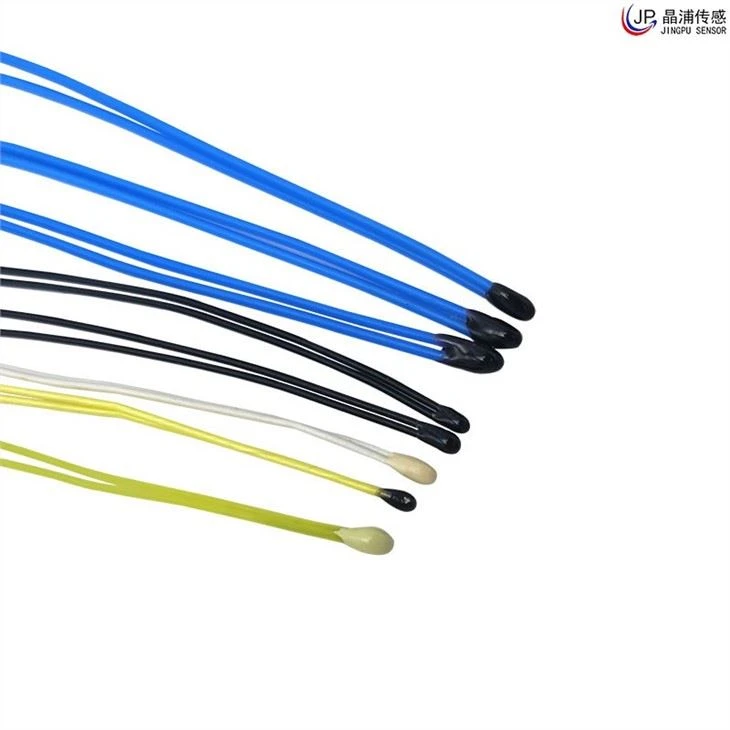
Selecting the right thermistor for the application is essential. Thermistors with lower resistance values and better thermal characteristics can be chosen to minimize self - heating. Our company offers a wide range of epoxy coated thermistors, including Battery NTC Thermistor Temperature Sensor, Fire Alarm NTC Thermistor, and High Accuracy NTC Thermistor, which are carefully designed to meet different application requirements and minimize self - heating effects.
Conclusion
In conclusion, epoxy coated thermistors are indeed subject to self - heating due to the electrical power dissipation within the thermistor element. However, by understanding the factors that contribute to self - heating and implementing appropriate mitigation strategies, such as current limitation, heat dissipation optimization, and proper thermistor selection, the negative effects of self - heating can be minimized.
If you are looking for high - quality epoxy coated thermistors for your applications, we are here to help. Our products are designed to provide accurate temperature measurements and reliable performance. Whether you need a thermistor for a battery management system, a fire alarm, or a high - precision measurement device, we have the right solution for you. We welcome you to contact us for more information and to discuss your specific requirements. Let's work together to ensure the success of your projects.
References
- "Thermistors: Theory, Design, and Applications" by S. Middelhoek and S. A. Audet.
- "Electronic Instrumentation and Measurement Techniques" by Albert D. Helfrick and William D. Cooper.


