


Temperature Sensor
What is Temperature Sensor
Temperature sensors are all around us, many devices we encounter every day will contain a temperature sensor to ensure they do not overheat, for example, mobile phones, computers, hairdryers etc.
Temperature sensors are also used for applications in monitoring the atmosphere, for example, cabin temperature in planes, the temperature of the individual pods on the London Eye, and the temperature of the home.
Benefits of Temperature Sensor
Low-cost: The temperature sensors are mentioned to be low-cost, suggesting that they are affordable and cost-effective compared to other options in the market.
Easy installation: The text states that the temperature sensors are easy to install, implying that they can be quickly and easily set up for use.
Corrosion-proof and rugged construction: The temperature sensors are described as having corrosion-proof and rugged construction, indicating that they are durable and can withstand harsh environments.
Adaptability to data loggers and data acquisition systems: The temperature sensors are mentioned to be adaptable to data loggers and data acquisition systems, suggesting that they can be easily integrated into existing monitoring systems.
Waterproof: The temperature sensors are said to have 'O' ring protection against water ingression, making them completely waterproof. This feature ensures their reliability and longevity in wet or submerged environments.
Unaffected by changes in atmospheric pressure: The temperature sensors are stated to be unaffected by changes in atmospheric pressure, indicating that they can provide accurate temperature readings regardless of variations in air pressure.
-
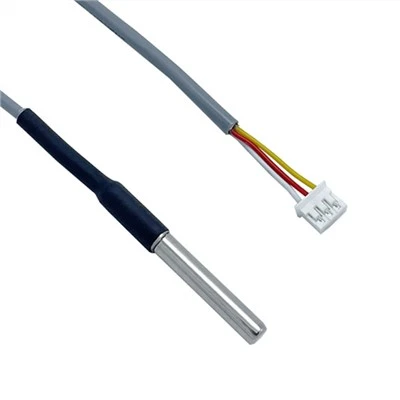
![Waterproof DS18B20 Temperature Sensor]() Waterproof DS18B20 Temperature SensorRead More
Waterproof DS18B20 Temperature SensorRead More. Comply for RoHS standard. Digital signal output. Operating temperature range: -20℃~+80℃. Stainless steel tube Φ6*50mm
-
![Temperature Sensor NTC 10K B3535 1M 1.5M 4M Length]() Temperature Sensor NTC 10K B3535 1M 1.5M 4M LengthRead More
Temperature Sensor NTC 10K B3535 1M 1.5M 4M LengthRead MoreTemperature Sensor NTC 10K B3535 1M 1.5M 4M Length is one NTC thermistor sensor. Temperature sensor NTC thermistors are usually built as metal oxides ceramic sinters. Producers carefully select
-
![Temperature Sensor NTC Thermistor 300mm Length IP67 Protection Degree]() Temperature Sensor NTC Thermistor 300mm Length IP67 Prote...Read More
Temperature Sensor NTC Thermistor 300mm Length IP67 Prote...Read MoreTemperature Sensor NTC Thermistor 300mm length IP67 protection degree. Temperature sensor NTC thermistors are usually built as metal oxides ceramic sinters. Producers carefully select thermistor
-
![NTC Thermistor 10K Ohm 3984K 2C 24AWG Black]() NTC Thermistor 10K Ohm 3984K 2C 24AWG BlackRead More
NTC Thermistor 10K Ohm 3984K 2C 24AWG BlackRead MoreThe item is NTC Thermistor 10K Ohm 3984K 2C 24AWG Black.The NTC thermistor sensor 10K Ohm 3984K is a compact NTC thermistor. It is designed for temperature sensing and compensation. It provides
-
![Single Insulated TPE Temperature Probe 5*20mm]() Single Insulated TPE Temperature Probe 5*20mmRead More
Single Insulated TPE Temperature Probe 5*20mmRead MoreThe item is one Single Insulated TPE Temperature Probe 5*20mm. This TPE temperature probe consists of a NTC thermistor soldered to a single insulated TPE extension cable. The temperature sensor and
-
![955mm Length NTC Thermistor Sensor Brass Temperature Probe]() 955mm Length NTC Thermistor Sensor Brass Temperature ProbeRead More
955mm Length NTC Thermistor Sensor Brass Temperature ProbeRead MoreThe item is one 955mm Length NTC thermistor Sensor Brass Temperature probe.The NTC thermistor sensor brass temperature probe is a compact NTC thermistor. It is designed for temperature sensing and
-
![NTC Thermistors, Standard Lug Sensors 150celsius Degree]() NTC Thermistors, Standard Lug Sensors 150celsius DegreeRead More
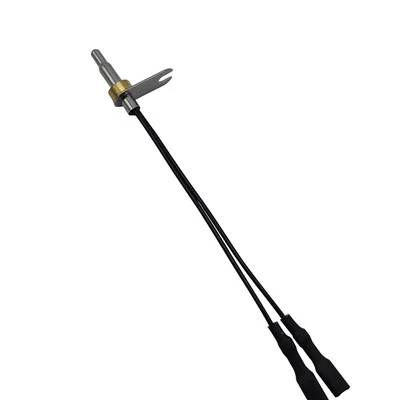
NTC Thermistors, Standard Lug Sensors 150celsius DegreeRead MoreThe item is one NTC Thermistors, Standard Lug Sensors 150celsius degree. It's used for temperature measurement.A NTC thermistor chip is soldered to AWG#26 multi-stranded silver plated copper leads
-
![SUS 304 Type Temperature Probe NTC Thermistor AC750V 1mA]() SUS 304 Type Temperature Probe NTC Thermistor AC750V 1mARead More
SUS 304 Type Temperature Probe NTC Thermistor AC750V 1mARead MoreSUS 304 Type Temperature Probe NTC Thermistor AC750V 1mA is a type of thermistor whose resistance decreases as the temperature increases. They are typically made from ceramics materials such as
-
![Professional Grade Temperature Detection Probe]() Professional Grade Temperature Detection ProbeRead More
Professional Grade Temperature Detection ProbeRead MoreThis professional-grade temperature detection probe is specifically designed for industrial monitoring, scientific experiments, and high-precision temperature control systems. It is the core tool for
-
![Epoxy Resin Dipping Multilayer Element NTC Thermistor]() Epoxy Resin Dipping Multilayer Element NTC ThermistorRead More
Epoxy Resin Dipping Multilayer Element NTC ThermistorRead MoreThe item is Epoxy resin dipping multilayer element NTC thermistor. A thermistor is a temperature sensitive resistor. They are often used a a temperature sensor. The term thermistor is a contraction
-
![NTC Thermistor 10K Epoxy Coated Tolerance ±1% B-3950K, Wire Length 820mm]() NTC Thermistor 10K Epoxy Coated Tolerance ±1% B-3950K, Wi...Read More
NTC Thermistor 10K Epoxy Coated Tolerance ±1% B-3950K, Wi...Read MoreNTC Thermistor 10K Epoxy coated tolerance ±1% B-3950K, wire length 820mm. It is a temperature sensitive resistor. They are often used as a temperature sensor. The term thermistor is a contraction of
-
![Lug Terminal Type NTC Sensor Assembly 150mm 250mm 300mm Length]() Lug Terminal Type NTC Sensor Assembly 150mm 250mm 300mm L...Read More
Lug Terminal Type NTC Sensor Assembly 150mm 250mm 300mm L...Read MoreTemperature sensor is one lug terminal type NTC sensor assembly 150mm 250mm 300mm length. It is a temperature sensitive resistor. They are often used as a temperature sensor. The term thermistor is a


Why Choose us
Quality assurance
We prioritize delivering high-quality services, and our output is subjected to quality checks to ensure that our clients receive the best possible services.
Customer support
Our customer support team is available round the clock to address any concerns or queries that customers may have.
Quality services
We offer top-quality products or services to our clients and are committed to delivering beyond their expectations.
Experience
We have a team of highly experienced professionals who offer expert advice and services to help you achieve your goals.
Types of Temperature Sensor



Resistance Temperature Detectors (RTDs)
The basic concept is that the resistance in metal reflects changes in temperature and that difference in resistance is what RTDs measure. An RTD is a resistor with well defined resistance vs. temperature properties. Platinum is the most common and accurate material used to develop RTDs.
The advantages of RTDs stem from their stability, accuracy, repeatability and fairly wide temperature range. The stability and accuracy derive from their almost linear response to temperature changes. RTDs are often preferred for precision applications because of their accuracy and repeatability.
Configurations include two, three, and four wire options. The two-wire option is useful when lead length is short enough that resistance doesn't significantly affect measurement accuracy. A three-wire adds an RTD probe that carries the excitation current. This provides a way to cancel wire resistance. Four-wire is the most accurate, as separate force and sense leads eliminate the effect of wire resistance.
Thermocouples
Thermocouples are the workhorse temperature sensor type. They are used in many different applications. The advantages are numerous: Thermocouples are self-powered, require no excitation, can operate over a wide temperature range, and have quick response times.
Thermocouples are made by joining two dissimilar metal wires together. This causes a Seebeck Effect. The Seebeck Effect is a phenomenon in which a temperature difference of two dissimilar conductors produces a voltage difference between the two substances. It is this voltage difference that can be measured and used to calculate the temperature.
There are several types of thermocouples that are made from a variety of different material, which allows for different temperature ranges and different sensitivities. The different types are differentiated by designated letters. The most commonly used is the K type.
Thermistors
Thermistors, like RTDs, measure temperature changes caused by measurable resistance changes. Most Thermistors are made from polymer or ceramic material. In most cases, thermistors are cheaper but are also less accurate than RTDs. Most thermistors are available in two wire configurations.
The Negative Temperature Coefficient (NTC) thermistor is the most common thermistor type for temperature measurement. The NTC thermistor's resistance decreases as the temperature increases, thus producing a non linear temperature resistance relationship. This requires a significant correction to interpret the data correctly.
Fuel Consumption Increases
One of the very first indications that you might have a faulty coolant temperature sensor is when you notice a drop to your fuel economy.
● The reason this happens is as follows
The faulty sensor might send a wrong signal to the computer, leading to a miscalculation in the engine timing and fuel calculation.
● If the computer keeps receiving a cold signal from the faulty sensor, it will interpret this as if the engine is cold and continue to inject more fuel.
● This action will not only lead to poor fuel economy but more importantly, it can impact engine performance.
Check Engine Light Flashes
If your check engine light starts flashing, this could also indicate a faulty coolant temperature sensor. Any time this warning light comes on, our advice to car owners is to have it checked out immediately to avoid potential engine trouble.
If you are unable to figure out the trigger for the “check engine light” warning, visit a professional mechanic as soon as possible.
Engine Overheating
If the coolant temperature sensor malfunctions, it could cause your car engine to get overheated. While sometimes a faulty sensor sends a permanent cold signal to the engine, it can also send a permanent hot signal.
The computer will again miscalculate the signal and cause the engine to heat up instead of cooling it down. When this happens, the car might misfire, or it could lead to engine knocking.
Black Smoke from the Exhaust
Black smoke coming out of your car's exhaust pipe could be another indication that your car's coolant temperature sensor is faulty or failing. Here's what happens:
● Faulty readings from the coolant temperature sensor can cause the engine to miscalculate the air-fuel mix in the engine.
● Any time the air-fuel mix ratio is not in proportion, and if the fuel mixture becomes too rich, the fuel will not be able to burn up inside the combustion chamber.
● As a result, the fuel will burn up in the car's exhaust pipes which causes the exhaust to release black smoke.
● If the amount of black smoke coming from a car is excessive, it is best not to attempt to drive the car.
● If you notice this with your car, get your car checked out by a pro ASAP.
Don't Ignore the Warning Signs
The coolant temperature sensor is a crucial component for ensuring your engine performs at an optimal level. It is based on the signals from the sensor that the car computer calculates engine timing and fuel injection. If the signal is wrong, this important calculation will be misjudged.
If you notice any of the above signs, have your car checked immediately to avoid potential engine trouble.
How to Choose the Right Temperature Sensor?
Temperature Range: Determine the temperature range over which you need to measure. Some sensors are suitable for a wide range, while others are more limited.
Accuracy: Consider the level of accuracy required for your application. Some sensors, provide high accuracy, while others, like thermocouples, offer a broader range but with slightly lower accuracy.
Response Time: Different sensors have different response times. In applications where quick temperature changes need to be captured, such as in control systems, a fast response time is crucial.
Stability: Some sensors, are known for their stability over time. If long-term accuracy is important for your application, stability becomes a critical factor.
Linearity: Ensure that the sensor provides a linear response within the temperature range of interest. This simplifies the calibration and conversion of electrical signals to temperature readings.
Environmental Conditions: Consider the environmental conditions in which the temperature sensor will be used. Some sensors are more suitable for harsh environments or conditions with electromagnetic interference.
Cost: Different sensors come at different price points. Ensure that the sensor you choose fits within your budget while still meeting your requirements.
Sensor Size and Form Factor: The physical size and form factor of the sensor may be important, especially in applications with limited space.
Calibration and Interfacing: Consider the ease of calibration and the interfacing requirements for the sensor. Some sensors may require specialized interfaces or signal conditioning.
Long-Term Reliability: For applications where reliability over time is essential, choose a sensor with a proven track record of long-term performance.
Industry Standards: Some industries have specific standards or requirements for temperature sensors. Ensure that the sensor you choose complies with these standards if applicable.
Measurement Method: Decide whether you need contact or non-contact temperature measurement. For non-contact measurement, consider infrared sensors or thermocouples, while contact methods include RTDs and thermistors.
Power Consumption: If your application has power constraints, consider the power consumption of the sensor.
Mounting and Installation: Consider the ease of mounting and installing the sensor. Some sensors may require special mounting considerations.
Extending the Life of Temperature Sensors
Avoid Tip Deformation
● The actual sensing part of a temperature sensor is very close to the tip of the probe, so keeping the tip protected is extremely important. This is especially important when it comes to Resistance Temperature Detectors (RTDs). RTDs consist of a very small platinum resistor that is very fragile. Any hammering or mechanical force on the tip of an RTD can ruin the sensor. Thermocouple junctions can also be broken or become unreliable if they are deformed or disturbed.
● Make sure that the probe fits securely into the bore that it is meant to go in. Temperature sensors should not have to be forced into place. If the sensors are not easy to install there is most likely some contamination (plastic overrun) in the bore hole that needs to be removed.
● Be careful with the temperature sensors when changing dies or servicing your machine. We see a lot of bent temperature sensors that no longer work correctly after being removed and reinstalled in a different die, because they were treated roughly during the transition.
Avoid Contamination of Leads
While temperature sensors are not as prone to contamination as our other heating products, such as mica band heaters and cartridge heaters, it can still happen. Often what we see is plastic that has been melted and somehow made its way onto the temperature sensor leads. Depending on the type of lead wire insulation, and the type of plastic, the plastic can create a “short” between the leads. This is really a secondary junction. This causes problems in thermocouples and RTDs. It is very important to not allow the leads to be contaminated.
Avoid Over Temperature
● Published literature states that a J-type thermocouple is accurate up to 1382°F. However, keep in mind that this is the maximum temperature rating for the thermocouple junction. The insulation surrounding the thermocouple wire will not be rated to this high of a temperature. Often times what we see is that the fiberglass insulation around the thermocouple wire has got hot and burned through. This leads to a bare thermocouple wire that makes contact with the metal of a machine. This creates a secondary junction which then gives a bogus temperature reading and causes the machine to have problems.
● This same phenomenon can happen when using an RTD. In that case, the resistance that the controller sees changes drastically, thus giving a false temperature reading.
● If possible, run the thermocouple wire leads in open air where the temperature is much lower than the process temperature.
Take Care with Lead Routing
● A high percentage of the temperature sensors that we see fail have done so because the leads have been damaged in some way. Machines have sliding or moving parts, and can easily pinch or nick leads if care is not taken when routing the leads.
● A stainless steel hose will help with deflecting mechanical force, but can still be crushed.
● A stainless steel over braid can help with mechanical wear, or rubbing, but again it is best to avoid this scenario, if possible.
● Teflon leads will be moisture resistant, but it is always better if temperature sensors can be kept dry. Thermocouple wire will rust if exposed to a high-moisture environment and, over time, will fail.
This is Hefei Jingpu Sensor Technology Co.,Ltd. Jingpu Sensor is a national high-tech enterprise integrating R&D, production and sales of thermistors and temperature sensors. The products include various epoxy-encapsulated and glass-encapsulated thermistors, as well as various temperature sensor assemblies, which are widely used in medical (Eg: Supporting monitors, medical equipment, bacterial incubators, medical refreigerators, etc.), smart wear, Automobile (Eg: Water temperature, oil temperature, air conditioner, filter, intake pressure temperature, steering wheel, rearview mirroe, tire, battery pack, etc.), domestic appliances (Eg: Air conditioner, refrigerator, electric water heater, induction cooker, boiling water boiler, electronic Calendar, etc.), mobile power, fire alarm, meteorology, ocean and other fields.


Certificate
ISO9001:2018 Quality Management System,ISO13485 Certificate, CE certificate, Biocompatibility Test Report


Asked Questions
Hefei Jingpu Sensor Technology Co., Ltd. is one of the most professional temperature sensor manufacturers and suppliers in China, specialized in providing high quality customized products. We warmly welcome you to wholesale cheap temperature sensor in stock here and get free sample from our factory. For price consultation, contact us.
Freezer Temperature Sensor, High Temperature NTC Temperature Sensor, Surface Mounted Temperature Sensor